About the course
About the Course
Course Type
Executive Leadership | AI Governance Capstone Simulation
Institution
C-Lab Institute
Overview
Artificial Intelligence in fast-scaling tech start-ups moves at the speed of innovation — but governance often struggles to keep up.
This capstone is the culminating stage of the C-Lab Institute AI Responsibility pathway. Participants are placed in a high-growth SME technology company that has rapidly deployed an AI-powered product now facing customer complaints, investor scrutiny, and emerging regulatory risk.
Revenue is accelerating.
Media attention is rising.
Governance controls are minimal.
The leadership team must decide whether to:
Scale aggressively,
Slow down and redesign safeguards,
Or restructure governance before further deployment.
This is not a theoretical discussion.
It is a board-level decision under pressure.
Capstone Objective
Participants will act as Chair of the AI Governance & Risk Committee and prepare a formal Board Advisory Memorandum recommending a responsible scaling strategy.
The capstone evaluates the leader’s ability to:
• Identify commercial, regulatory, and reputational risks
• Assess data governance and model integrity weaknesses
• Evaluate bias, security, and safety exposure
• Design scalable oversight and accountability structures
• Propose testing, monitoring, and incident response mechanisms
• Make a defensible scale / pause / redesign recommendation
What Participants Must Submit
A structured 1,800–2,000 word Executive Governance Brief including:
Risk Identification
Strategic risk
Regulatory exposure
Data governance gaps
Bias and fairness risk
Model reliability concerns
Cybersecurity vulnerabilities
Investor and reputational risk
Governance Framework Proposal
Board oversight structure
Defined AI accountability roles
Human-in-the-loop controls
Pre-deployment testing standards
Ongoing monitoring & model audit
Incident reporting and escalation process
Vendor and third-party accountability
Transparency & customer disclosure measures
Scaling Decision
Scale Immediately / Scale with Conditions / Pause & Redesign
Conditions required for responsible scaling
Clear 12-month governance roadmap
Reflection
“What does responsible AI leadership require when growth pressure conflicts with governance discipline?”
Assessment Criteria
Submissions are evaluated on:
• Depth of Risk Analysis
• Practicality of Governance Design
• Commercial & Ethical Balance
• Clarity of Scaling Decision Logic
• Executive-Level Strategic Judgement
Award
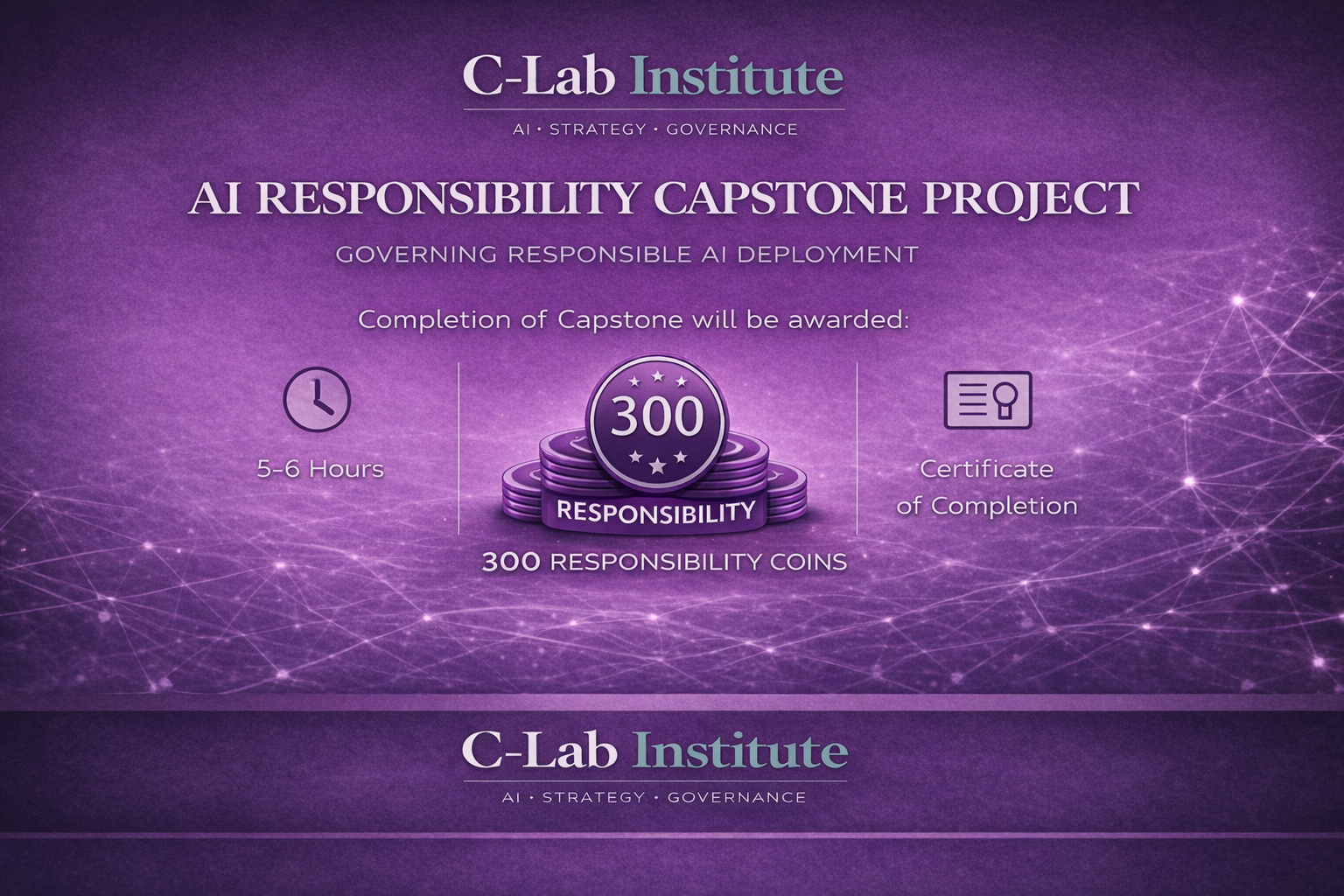
🏅 300 Responsibility Coins
📜 C-Lab Institute AI Responsibility Capstone Certificate
Primary 3R Dimension: Responsibility (Do)
Progression Path: Leader → Fellow
Requirements
- Programme Alignment:C-Lab AI Leadership Pathway – Responsibility Stage
- Coin Allocation:Responsibility Coins
- Prerequisite:Completion of AI Readiness for Leaders
Course content
Enrolment options
AI Responsibility Capstone: Scaling Fast vs Governing Smart - SME tech start-up
About the Course
Course Type
Executive Leadership | AI Governance Capstone Simulation
Institution
C-Lab Institute
Overview
Artificial Intelligence in fast-scaling tech start-ups moves at the speed of innovation — but governance often struggles to keep up.
This capstone is the culminating stage of the C-Lab Institute AI Responsibility pathway. Participants are placed in a high-growth SME technology company that has rapidly deployed an AI-powered product now facing customer complaints, investor scrutiny, and emerging regulatory risk.
Revenue is accelerating.
Media attention is rising.
Governance controls are minimal.
The leadership team must decide whether to:
Scale aggressively,
Slow down and redesign safeguards,
Or restructure governance before further deployment.
This is not a theoretical discussion.
It is a board-level decision under pressure.
Capstone Objective
Participants will act as Chair of the AI Governance & Risk Committee and prepare a formal Board Advisory Memorandum recommending a responsible scaling strategy.
The capstone evaluates the leader’s ability to:
• Identify commercial, regulatory, and reputational risks
• Assess data governance and model integrity weaknesses
• Evaluate bias, security, and safety exposure
• Design scalable oversight and accountability structures
• Propose testing, monitoring, and incident response mechanisms
• Make a defensible scale / pause / redesign recommendation
What Participants Must Submit
A structured 1,800–2,000 word Executive Governance Brief including:
Risk Identification
Strategic risk
Regulatory exposure
Data governance gaps
Bias and fairness risk
Model reliability concerns
Cybersecurity vulnerabilities
Investor and reputational risk
Governance Framework Proposal
Board oversight structure
Defined AI accountability roles
Human-in-the-loop controls
Pre-deployment testing standards
Ongoing monitoring & model audit
Incident reporting and escalation process
Vendor and third-party accountability
Transparency & customer disclosure measures
Scaling Decision
Scale Immediately / Scale with Conditions / Pause & Redesign
Conditions required for responsible scaling
Clear 12-month governance roadmap
Reflection
“What does responsible AI leadership require when growth pressure conflicts with governance discipline?”
Assessment Criteria
Submissions are evaluated on:
• Depth of Risk Analysis
• Practicality of Governance Design
• Commercial & Ethical Balance
• Clarity of Scaling Decision Logic
• Executive-Level Strategic Judgement
Award
🏅 300 Responsibility Coins
📜 C-Lab Institute AI Responsibility Capstone Certificate
Primary 3R Dimension: Responsibility (Do)
Progression Path: Leader → Fellow
- Enrolled students: There are no students enrolled in this course.